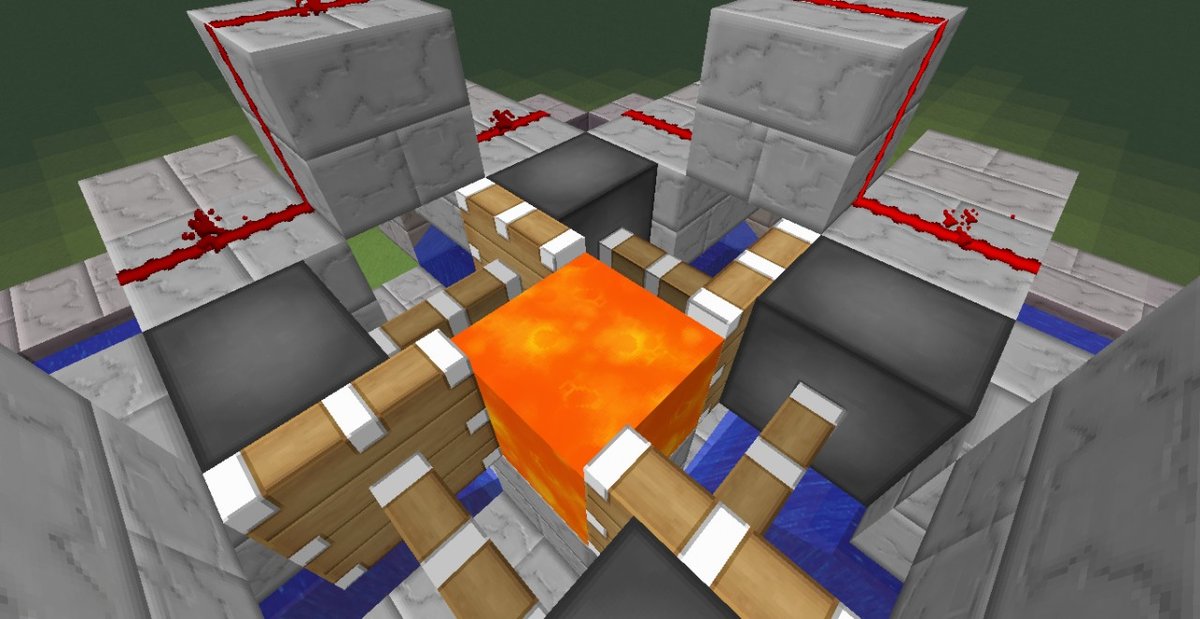
For any serious Minecraft architect, explorer of the Nether, or crafter of Wither cages, the constant demand for obsidian can be a significant bottleneck. While mining it manually is an option, the true mark of a seasoned player lies in automating the tedious. Welcome to the deep end: Advanced Automatic Obsidian Generator Builds and Redstone Systems. This isn't about placing a bucket and swinging a pickaxe; it's about engineering a self-sustaining, high-yield operation that churns out obsidian while you focus on bigger, blockier ambitions.
At a Glance: Crafting Infinite Obsidian
- The Core Principle: Obsidian forms when lava sources meet flowing water. Automation focuses on precisely controlling this interaction.
- Redstone is Key: Timers, observers, pistons, and dispensers orchestrate lava and water placement, and sometimes even block destruction.
- Lava Sourcing: Dripstone farms with cauldrons are the most efficient, renewable source for truly infinite lava.
- Generation Methods: From simple single-block setups for player mining to complex arrays with automated collection.
- Optimization Matters: Fine-tuning Redstone timings, managing lag, and ensuring efficient collection are crucial for advanced builds.
- Challenges: Dealing with empty buckets, precise timing for player-mined setups, and scaling without performance hitches.
Why Automate Obsidian Production? It's More Than Convenience.
Think about the sheer volume of obsidian required for significant projects: a full beacon pyramid, a robust Nether portal hub, or protective shells around critical builds. Manually gathering thousands of blocks is a monumental, soul-crushing task. An advanced automatic obsidian generator isn't just a convenience; it's a strategic infrastructure investment.
It frees you from the pickaxe grind, providing a consistent supply that scales with your ambition. This allows you to allocate your precious playtime to exploration, advanced farming, complex Redstone contraptions, or epic builds, knowing your obsidian reserves are continuously growing. It's about empowering your gameplay, not just simplifying a single step.
The Foundation: Obsidian Mechanics and the Automation Challenge
Obsidian, as you know, is created when a lava source block comes into contact with flowing water. The immediate challenge for automation isn't how to make obsidian, but how to reliably and repeatedly create a new obsidian block in a predictable location and then, often, how to automatically collect it.
Early, simple generators often involve pouring water over lava, breaking the resulting obsidian, and repeating the process. But "advanced automatic" implies removing the player from this loop almost entirely, or at least minimizing their interaction to just collecting the final product. This requires a robust supply of lava, a precise mechanism for placing both liquids, and a system to either present the obsidian for quick mining or to mine it automatically.
Sourcing Your Endless Lava: The Dripstone Revolution
Before you even think about pistons and observers, you need an inexhaustible supply of lava. While you could lug buckets from the Nether, that's far from automatic. The game-changer for infinite lava came with the introduction of dripstone.
Dripstone Lava Farms are the bedrock of any truly advanced obsidian generator. Here's the gist:
- Place a lava source block above a pointed dripstone block.
- Below the pointed dripstone, place a cauldron.
- The dripstone will slowly drip lava into the cauldron, eventually filling it.
- Once full, a hopper beneath the cauldron can extract the lava bucket (if placed there by a dispenser) or, more simply, collect the lava itself into a storage system.
By creating large arrays of these dripstone setups, you can generate vast quantities of lava without ever needing to visit the Nether. This lava can then be piped (via Redstone-controlled dispensers) directly into your obsidian generator.
Designing the Generation Core: Water, Lava, and Precision
The heart of your advanced generator lies in how you manage the interaction between water and lava. The goal is to consistently create an obsidian block in the exact same spot, allowing for efficient Redstone timing and collection.
Basic Principle: The One-Way Flow
Imagine a single block space. You want lava to flow into it, then water to flow over the lava, forming obsidian. After the obsidian forms, it needs to be broken, and the cycle repeats.
- Lava Placement: A dispenser filled with lava buckets (or a direct lava flow if using very specific pipe mods, though we're focusing on vanilla-compatible Redstone here) places a lava source block.
- Water Flow: Immediately after, or simultaneously, water flows from a specific direction to hit the lava source, creating obsidian.
- Obsidian Detection/Mining: An observer detects the obsidian block appearing. This signal triggers either a player-mining prompt or an automated mining system.
- Reset: After mining, the cycle needs to reset – often by retracting pistons, allowing water to clear, and then initiating the lava placement again.
The Reddit Inspiration: Timing for Player Efficiency
A common approach, as highlighted in various communities, including Reddit, focuses on generating obsidian for player mining but doing so with such precision that it maximizes efficiency. One user designed an obsidian generator that works perfectly with an Efficiency V pickaxe, noting: "It places the lava just right, if you’re using an efficiency 5 pickaxe. This means it places it just after you break it, not immediately because you can’t really collect it then."
This insight is crucial. If you're relying on a player for mining, the generator needs to:
- Place lava: Then trigger water to form obsidian.
- Wait: Just long enough for the player to break the obsidian.
- Repeat: Place new lava, form obsidian, wait.
This requires careful Redstone timing, typically using repeaters to introduce delays between the lava placement, water flow, and any subsequent actions. If you're building a simpler how to build an obsidian generator, mastering this basic timing is your first step.
Redstone Deep Dive: The Brains Behind the Blocks
Redstone is where "automatic" truly comes alive. Advanced generators rely on precise timing, sequence control, and robust detection mechanisms.
Essential Redstone Components for Obsidian Generation:
- Repeaters: Crucial for creating delays. Each repeater adds 0.1 to 0.4 seconds (1 to 4 Redstone ticks) of delay, allowing you to fine-tune the timing between lava placement, water flow, and mining.
- Comparators: Used for detecting items in containers (like full cauldrons or empty buckets in a dispenser) or for creating sophisticated clock circuits.
- Observers: Indispensable! An observer detects block updates. You can use it to:
- Detect when a lava source block is placed.
- Detect when an obsidian block is formed.
- Detect when an obsidian block is broken (by a player or automated means).
- These detections become the triggers for the next step in your automated sequence.
- Pistons (Sticky & Regular): For pushing/pulling blocks, controlling water flow, or even moving the obsidian block itself into a collection area. Sticky pistons are key for retracting blocks.
- Dispensers: Absolutely vital for placing and picking up lava buckets and water buckets. They also work for collecting empty buckets, though this can be a sticking point.
- Hopper Clocks: A simple, reliable way to create a repeating pulse (a "tick" for the system). Two hoppers pointing into each other, with an item moving between them, connected to a comparator.
- Redstone Dust: Connects everything.
Building a Basic Redstone Loop:
Consider a setup where a dispenser places lava, an observer detects the obsidian, and then something happens.
- Lava Dispenser: A dispenser is filled with lava buckets.
- Water Flow: Water is strategically placed so it flows over the dispensed lava.
- Observer Trigger: An observer watches the block where obsidian will form. When obsidian appears, it sends a Redstone pulse.
- Action Sequence: This pulse can:
- Trigger a piston to momentarily block water flow to prepare for the next lava placement.
- Initiate a mining sequence (if automated).
- Signal a collection system.
- Crucially, it also needs to re-arm the dispenser to place the next lava bucket.
The Empty Bucket Conundrum: A Redstone Challenge
One of the pain points for many advanced generators, particularly those using dripstone farms, is managing empty lava buckets. When a dispenser places lava, it leaves an empty bucket. This empty bucket then needs to be collected, refilled (by returning it to the dripstone farm), and returned to the dispenser.
Reddit discussions often highlight this problem: "I sadly don't know yet how to make it filter the empty buckets but I'll update when I can." This points to a common hurdle.
Solutions for Empty Buckets:
- Filtered Hoppers: Use a hopper chain with specific item filters (e.g., locking a hopper with an empty bucket) to route empty buckets back to your dripstone lava farm's collection point.
- Dropper/Dispenser Loops: A series of droppers can sort items. When an empty bucket comes out of the obsidian generator's dispenser, an item sorter diverts it to a separate chest or a return path.
- Dedicated Return Lines: A minecart-with-chest system or a water stream can transport empty buckets back to the lava farm.
This aspect adds significant complexity but is essential for truly autonomous, closed-loop systems.
Scaling Up: From Single Block to Obsidian Factories
Once you've mastered the single-block generation loop, the next step is to scale.
Multi-Block Arrays
Instead of one generation point, imagine 5, 10, or even 20 identical generation points working in parallel. This exponentially increases your obsidian yield.
- Synchronized Clocks: A single, powerful Redstone clock can power multiple generation units simultaneously.
- Distributed Power: Use Redstone lines, repeaters, and possibly Redstone links (in some modded versions, though we're focusing on vanilla) to deliver signals to each unit.
- Independent Modules: You can also design each generation unit as a self-contained module with its own observer-based logic, reducing the need for long, complex Redstone lines. This improves fault tolerance.
Automated Mining vs. Player-Assisted
The "automatic" aspect can diverge here:
- Player-Assisted, High-Efficiency: As discussed with the Reddit example, the generator precisely creates obsidian for you to quickly mine with an Efficiency V/Haste II pickaxe. This is excellent for early-to-mid-game "automation" where full block destruction is complex.
- Fully Automated Mining: This is where things get truly advanced.
- Wither Cages: A Wither trapped in a specific configuration can break obsidian without destroying surrounding blocks if positioned correctly. This is an extremely high-tier, dangerous, and resource-intensive solution but provides truly hands-off destruction.
- TNT/Charged Creepers: Less precise and often destructive to the generator itself unless meticulously designed. Not generally recommended for continuous, reliable obsidian generation.
- Player-Simulating Mods: In modded Minecraft, "perimeters loaders" or "quarry" style machines might simulate a player or automatically mine, but this falls outside pure vanilla Redstone.
For most vanilla advanced builds, optimizing for player mining with a Haste II beacon (as the Reddit post suggests tuning Redstone repeaters for) is the more practical and safer approach.
Optimizing Your Build: Efficiency and Lag Management
An advanced generator isn't just about making obsidian; it's about making it well.
- Redstone Tick Efficiency: Every Redstone action consumes server ticks. Minimize unnecessary loops, long Redstone lines, and rapidly flashing lights. Consolidate clocks where possible.
- Entity Reduction: Minimize items on the ground, minecarts, or unnecessary mobs. These contribute to lag. Ensure your collection system is fast enough to clear items before they despawn.
- Compact Design: While large arrays are great for yield, a compact design for each module minimizes resource usage and Redstone signal travel time, contributing to overall efficiency.
- Chunk Loading: For continuous operation in single-player, ensure your generator is within loaded chunks. In multiplayer, consider a dedicated chunk loader if allowed on your server.
- Fail-Safes: What happens if a lava bucket isn't replaced? What if the collection system backs up? Include overflow protection (e.g., locking hoppers, emergency shut-offs).
Addressing Common Questions and Troubleshooting Tips
Q: My generator stops working after a while. What gives?
A: Check your lava supply first. Is your dripstone farm still producing? Are buckets getting stuck? Next, inspect your Redstone timings. A misaligned repeater or a burned-out Redstone torch can halt the entire sequence. Also, ensure your collection system isn't backed up, preventing new obsidian from forming or being collected.
Q: Why is my Redstone so slow, or why isn't it activating everything?
A: Redstone signals only travel 15 blocks. Use repeaters to boost the signal. Also, ensure your power source (lever, button, Redstone block, etc.) is providing a strong enough pulse to initiate the entire sequence. Check for any Redstone dust paths that might be broken or accidentally powering unintended blocks.
Q: How do I deal with empty buckets from dispensers?
A: This is a tricky one! As discussed, use filtered hoppers or a dropper/dispenser line to sort and transport empty buckets back to your lava farm for refilling. This closed-loop system is essential for truly automatic operation.
Q: Can I use this for netherite generation?
A: No. Netherite scrap is found in the Nether and processed with gold. Obsidian is used to make the actual Nether portal frames to access the Nether, as well as an essential component for the crafting table to make a beacon.
Beyond Vanilla: A Nod to Modded Systems
While this guide focuses on vanilla Redstone, the world of modded Minecraft offers even more powerful automation tools. For instance, the Advanced Generators mod by bdew (supported across various Minecraft versions like 1.7.10-1.12.2) provides "modular power generators" like Gas Turbines and Steam Turbines. While it doesn't generate obsidian itself, such power generation systems could easily fuel vast Redstone contraptions, sophisticated item transport networks, or even power block-breaking machines (like quarries in other mods) that could eventually be integrated into an even more advanced obsidian generation and processing system. The core obsidian generation, however, remains rooted in the water-meets-lava mechanic.
Your Next Steps to Obsidian Mastery
You've delved into the intricacies of Advanced Automatic Obsidian Generator Builds and Redstone Systems. Now it's time to build. Start small, perhaps with a single-block player-assisted generator, and then incrementally add complexity: a dripstone farm, then automated bucket handling, then scaling to multiple generation points. Experiment with different Redstone timings. Observe how blocks interact. The beauty of Redstone is its logical, predictable nature, rewarding careful planning and iterative refinement.
The journey to infinite obsidian is a testament to your engineering prowess. Go forth, build, and never run out of obsidian again!